Having deployed a new printing solution in a large University environment, we were faced with all sorts of printing errors, slow printing, and out of memory errors on the printers themselves; specifically when printing PDFs. This is related to how the PDFs are processed, which becomes a challenge in a higher education environment where the PDFs can be considerably complex. This was not only providing a poor user experience, it was becoming a support nightmare to manage when you have thousands of Students and Academics creating and printing PDFs. After some advice, research and testing we found that setting the Adobe “Print As Image” (cPrintAsImage) option made a big difference to the quality and stability of the solution, clearing up most of the printing errors previously experienced. This option changes the way Adobe works by sending the output to the printer as an image file rather than a combination of different elements.
As per the following screen shot users can change it manually by selecting the “Advanced” button in the Print window and then selecting the “Print As Image” check box in the Advanced Print Setup pop-up window.
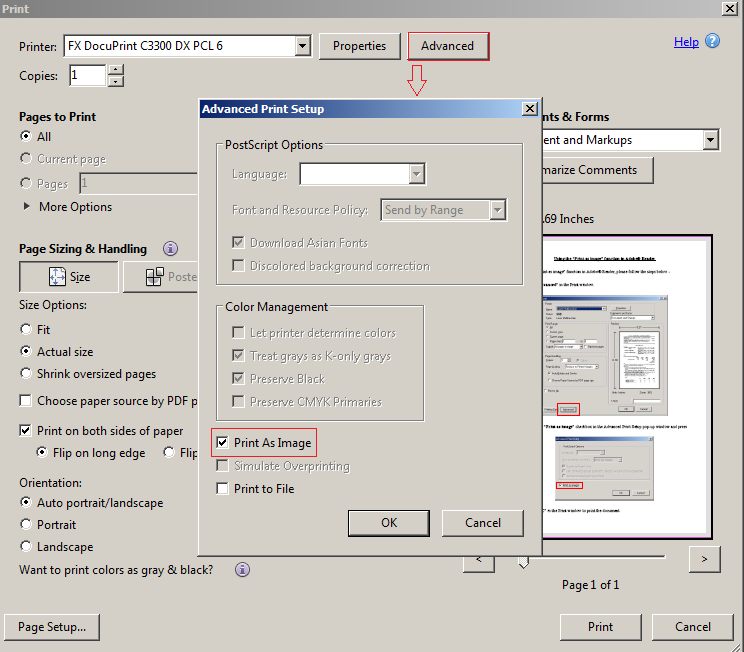
However, the challenge was how to automate this for all users, including the various versions of Adobe Acrobat and Acrobat Reader in use. Furthermore, we had to also ensure that the “Print As Image” (cPrintAsImage) flag was set for all network printers. So I wrote a script, which we implemented to run at logon 🙂
Here is the SetAdobePrintAsImage.vbs script:
' This script will set the Adobe Acrobat and/or Acrobat Reader
' "Print as image" option (cPrintAsImage registry key structure)
' for all valid printers in the user's session.

' There are simple mechanisms in place so that you can easily
' exclude:
' - Printer by name and/or UNC path
' - Printer by port
' - Microsoft RDP Client Printers
' - Citrix ICA Client Printers

' You simply set the registry key structure in the arrKeys array
' up to the version number of the Adobe Acrobat and/or Acrobat
' Reader products you want to check. The default behaviour is to
' check for the following products:
' - Acrobat Reader 9
' - Adobe Acrobat 9
' - Acrobat Reader 10
' - Adobe Acrobat 10

' If the registry key structure defined in the arrKeys array does
' not exist, no action will be taken.

' Adobe changed the way it stores the value and data under the
' cPrintAsImage key from version 9 onwards. If you need to run
' this against older versions, this script will need further
' modification.

' The value written under the cPrintAsImage key must be a lower
' case t. The "Print as image" option will not be selected if an
' upper case T is used.

' Whilst this script is only checking the registry for valid Adobe
' products, the script can easily be changed to check for files,
' such as Acrobat.exe and AcroRd32.exe.

' Important: There could be two possible timing issues with this
' script:
' 1) The "HKCU\Software\Adobe" registry key structure does not
' exist at the time the script runs for new logons/profiles.
' A possible solution for this would be to use the HKLM
' structure in the array.
' 2) The Printers pushed out by Group Policy Preferences (GPPs)
' or Deployed Printers have not been created at the time the
' script runs. This script may therefore need to be added to
' the "Items to run at logon" policy, or added as a value to
' the registry "Run" key. Either way, it must be setup so that
' it runs after the network printers have been deployed.

' Release 1.0
' Written by Jeremy@jhouseconsulting.com on 30th May 2012.

Option Explicit

Dim objShell, objNetwork, objPrinter, intCounter, arrKeys, strKey
Dim arrExcludePrinters, arrExcludePrinterPorts,i, blnDebug
Dim blnExcludeRDPClientPrinters, blnExcludeCitrixClientPrinters
Dim blnExcludePrinter

'******************* Variables to set *************************

' Add the key structures to the array to represent the products
' and versions deployed in the environment.
arrKeys = Array("HKCU\Software\Adobe\Acrobat Reader\9.0", _
 "HKCU\Software\Adobe\Adobe Acrobat\9.0", _
 "HKCU\Software\Adobe\Acrobat Reader\10.0", _
 "HKCU\Software\Adobe\Adobe Acrobat\10.0")

' These are the printers we want to exclude.
arrExcludePrinters = Array("Microsoft XPS Document Writer","Generic / Text Only")

' These are the printer ports we want to exclude.
arrExcludePrinterPorts = Array("XPSPort")

' Exclude Microsoft RDP Client Printers
blnExcludeRDPClientPrinters = True

' Exclude Citrix ICA Client Printers
blnExcludeCitrixClientPrinters = True

' Do not set blnDebug to True when in production unless launching it using cscript.exe
blnDebug = False

'**************************************************************

set objShell = WScript.CreateObject("WScript.Shell")
Set objNetwork = CreateObject("WScript.Network")
Set objPrinter = objNetwork.EnumPrinterConnections

For Each strKey in arrKeys
 If RegKeyExists(strKey & "\General\cPrintAsImage") Then
 Call DeleteValues(strKey & "\General\cPrintAsImage")
 End If
 If RegKeyExists(strKey) Then
 If objPrinter.Count <> 0 Then
 i = 0
 For intCounter = 0 To (objPrinter.Count -1) Step 2
 If blnDebug Then
 WScript.Echo "UNC Path " & objPrinter.Item(intCounter) & " = " & _
 objPrinter.Item(intCounter +1)
 End If
 blnExcludePrinter = False
 If Instr(1,objPrinter.Item(intCounter +1),"redirected",1) > 0 Then
 If blnExcludeRDPClientPrinters Then
 blnExcludePrinter = True
 End If
 End If
 If Instr(1,objPrinter.Item(intCounter +1),"in session",1) > 0 Then
 If blnExcludeCitrixClientPrinters Then
 blnExcludePrinter = True
 End If
 End If
 If IsArray(arrExcludePrinters) Then
 If InArray(objPrinter.Item(intCounter +1),arrExcludePrinters) Then
 blnExcludePrinter = True
 End If
 End If
 If IsArray(arrExcludePrinterPorts) Then
 If InArray(objPrinter.Item(intCounter),arrExcludePrinterPorts) Then
 blnExcludePrinter = True
 End If
 End If
 If NOT blnExcludePrinter Then
 objShell.RegWrite strKey & "\General\cPrintAsImage\t" & i, objPrinter.Item(intCounter +1), "REG_SZ"
 i = i + 1
 End If
 Next
 Else
 If blnDebug Then
 WScript.Echo "No printers are mapped in this session."
 End If
 End If
 Else
 If blnDebug Then
 WScript.Echo "The " & strKey & " registry key structure does not exist."
 End If
 End If
Next

set objShell = Nothing
Set objNetwork = Nothing
Set objPrinter = Nothing

Wscript.Quit(0)

Function InArray(stritem,myarray)
 Dim i
 For i=0 To UBound(myarray)
 If strComp(stritem,myarray(i),1) = 0 Then
 InArray=True
 Exit Function
 End If
 Next
 InArray=False
End Function

Sub DeleteValues(strKeyPath)
 Dim strComputer, objReg, i, arrValueNames, arrValueTypes, return
 Dim strKeyRoot, HIVE
 CONST HKEY_LOCAL_MACHINE = &H80000002
 CONST HKEY_CURRENT_USER = &H80000001
 strComputer = "."
 Set objReg = GetObject("winmgmts:{impersonationLevel=impersonate}!\\" &_
 strComputer & "\root\default:StdRegProv")
 If instr(1,strKeyPath,"HKEY_LOCAL_MACHINE\",1) > 0 Then
 strKeyPath = Replace(strKeyPath,"HKEY_LOCAL_MACHINE\","")
 strKeyRoot = "HKLM"
 HIVE = HKEY_LOCAL_MACHINE
 End If
 If instr(1,strKeyPath,"HKLM\",1) > 0 Then
 strKeyPath = Replace(strKeyPath,"HKEY_LOCAL_MACHINE\","")
 strKeyRoot = "HKLM"
 HIVE = HKEY_LOCAL_MACHINE
 End If
 If instr(1,strKeyPath,"HKEY_CURRENT_USER\",1) > 0 Then
 strKeyPath = Replace(strKeyPath,"HKEY_CURRENT_USER\","")
 strKeyRoot = "HKCU"
 HIVE = HKEY_CURRENT_USER
 End If
 If instr(1,strKeyPath,"HKCU\",1) > 0 Then
 strKeyPath = Replace(strKeyPath,"HKCU\","")
 strKeyRoot = "HKCU"
 HIVE = HKEY_CURRENT_USER
 End If
 return = objReg.EnumValues (HIVE, strKeyPath,_
 arrValueNames, arrValueTypes)
 If return = 0 and IsArray(arrValueNames) Then
 For i = 0 To UBound(arrValueNames)
 objReg.DeleteValue HIVE, strKeyPath, arrValueNames(i)
 Next
 End If
 Set objReg = Nothing
End Sub

Function RegKeyExists(ByVal sRegKey)
' Returns True or False based on the existence of a registry key.
 Dim sDescription, oShell
 Set oShell = CreateObject("WScript.Shell")
 RegKeyExists = True
 sRegKey = Trim (sRegKey)
 If Not Right(sRegKey, 1) = "\" Then
 sRegKey = sRegKey & "\"
 End If
 On Error Resume Next
 oShell.RegRead "HKEYNotAKey\"
 sDescription = Replace(Err.Description, "HKEYNotAKey\", "")
 Err.Clear
 oShell.RegRead sRegKey
 RegKeyExists = sDescription <> Replace(Err.Description, sRegKey, "")
 On Error Goto 0
 Set oShell = Nothing
End Function
Enjoy!