Priming a Non-persistent Windows Image using an Autologon Process with an Auto Logoff Timer

Several years ago, and inspired by an article written by George Spiers to reduce login times, where “the second logon is quicker”, together with some code from Maurice Daly, I created a methodology and scripts that is designed to Autologon a non-persistent Session Host (both VDI and RDS), and then log it off again before another script will Start the Citrix Desktop Service (BrokerAgent).

It has been working flawlessly for years. However, I was never 100% happy with it because the process was using a domain (service) account for the Autologon process. The main challenge here was trying to change the password on a regular basis to stay compliant when managing multiple images. You cannot realistically do it without an outage. And in a 24×7 environment, it becomes difficult and onerous. I also felt that using a domain account can be “heavy” during a boot storm as you need to ensure you are excluding this account from profile management and policies where possible. Sometimes that is easier said than done. There is a level of risk here, as someone can easily make a change that will cause issues. The ability to roll the password and stay compliant was my biggest concern and where I got stuck for quite some time.
Read more

The Citrix Virtual Apps and Desktops & Desktops as a Service Health Check Script on Steroids

UPDATE: Version 1.5.9 released on 3rd March 2026. See below for all the details.

Since November 2014 many of us have been using the amazing Sacha Thomet’s XenApp and XenDesktop Health Check Script. I’ve made my own modifications to it over the years, but never contributed and shared anything publicly until June 2025. My motivation is to give the community some amazing visibility of their Citrix environments that they’ve never had before. I took the last release from Sacha, which was the February 2022 update, together with some modules I’d previously written, and overhauled the whole process from top to bottom, and wrote even more modules. Sacha has kindly committed my pull requests to his GitHub repository, which officially adds me as Contributor!

CVAD & DaaS Health Check Script on Steroids

Read more

The Maptek User Support Tool to Help Manage Vulcan Support Challenges

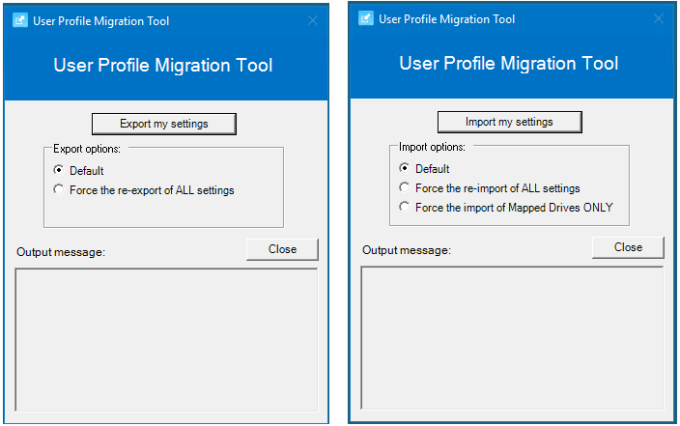
I would like to introduce you to a PowerShell tool I built in 2023 and have been continually developing and adding features until this release. If you or your customer runs Maptek Vulcan, especially in a virtualised desktop platform from Vendors such as Citrix, Omnissa, Parallels, Dizzion, Microsoft and Amazon, you may want to consider using this tool to assist users with the support challenges for Maptek products, specifically Vulcan and BlastLogic. It primarily empowers the users with the ability to set, change and verify required Vulcan variables, ODBC connections, and mapped drives. It also facilitates setting the TEMP & TMP variables to a RAM Disk (if present), for the current process only, before starting Vulcan.

The Maptek products aside, this tool can be used as a template and modified to help enhance the delivery and experience for any application.

The following screen shot shows the user interface in two forms. Can you spot the differences? I will explain below what this means and all the functions the tool provides.

Maptek User Support Tools

Background

Maptek Vulcan is specialised 3D mining software used for geological modelling, mine design, and mine planning. It has been widely used in the mining industry since the mid 1980s by Geologists, Surveyors, Mine and Geotechnical Engineers to analyse, visualise, and optimise mineral resources. It is also used for resource evaluation, feasibility studies, and operational planning. It integrates with many other mining applications.

From an IT Support point of view, it’s a beast of an application that has several limitations due to legacy code and settings that creates challenges for users when deployed into a Virtual Desktop platform. It’s written to run on high end laptops and workstations where users are not locked down too heavily. So when you add Cyber policies and locked down devices and desktops, it can be challenging for users to configure the software as needed without assistance.

Read more

The Micromine Alastri Hub Launcher Tool that leverages a RAM Disk for Temporary Data

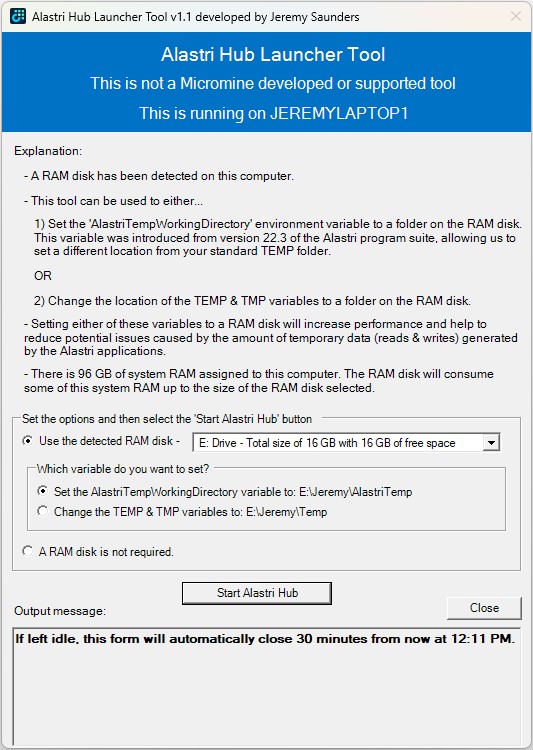
I would like to introduce you to a PowerShell tool I originally created in early 2024, which was in the research and planning stage for about 12 months previous to that whilst I was finding a suitable RAM Disk solution. If you or your customer runs Micromine Alastri Software, especially in a virtualised desktop platform from Vendors such as Citrix, Omnissa, Parallels, Dizzion, Microsoft and Amazon, you may want to consider using this tool to help increase performance and reduce potential issues caused by the amount of temporary data (reads & writes) generated and consumed by the Alastri applications.

Alastri Hub Launcher

Read more

Best Practice for the Active Setup StubPath value

It’s been a best practice for a long time to clear the Active Setup StubPath value per application to avoid the Active Setup processes from running at logon, impacting the user experience. This is a challenge we constantly have with Vendors and packaging teams. But blindly clearing the StubPath value could lead to application issues. So what happens when you need to go back and troubleshoot an issue with an application that may be related to what “should have” run via the Active Setup process. How do you know what the StubPath value was originally set to? Do you record it somewhere?

I’ve been running a script for years over my builds that simply renames the existing StubPath value to StubPath.Backup and time stamps it. This way you can always review what it should be, and make the necessary changes to allow for this.

Read more

Cold Starting and/or Hydrating Your Applications To Improve Their Startup Times

In the End User Computing (EUC) space we know that after the first time the application starts post reboot, the next time is faster. The first startup is referred to as a cold startup and all subsequent runs are warm startups. The first time the application starts, components of the application, such as the EXEs (executables) and DLLs (dynamic link libraries) need to be loaded from disk, which can delay the startup time. All subsequent runs will then read the data from the file system cache, which is memory managed by the Operating System.

Hydrate and Cold Start your applications

The way we prepare a system for a user is to cold start (pre-launch) the applications when the system starts. We do this by starting and then terminating each process, such as winword.exe.

Read more

ESRI ArcGIS Pro and Desktop License Type and Program Selector User Interfaces

Updated 17th July 2024

Here are two awesome User Interfaces (UI’s) I built that will compliment any ESRI ArcGIS Pro (AGP) and/or ArcGIS Desktop (AGD) deployment. More specifically from my point of view, they have been developed with a Citrix Published Application, VMware Horizon, Remote Desktop, VDI and AVD deployment in mind, giving the users the ability to easily switch licensing types and launching the different programs and tools, making life much easier for them.

ArcGIS Pro Challenges

  • Changing the licensing is not as simple as it seems, especially when launching it as a published application. This is because you have to change it from within the program once launched; and then the program needs to restart for the new licensing type to work. What that means is that the ArcGISPro.exe process will terminate and restart. Whilst that happens a published application session may log itself off, as there are no processes running to keep it open. The code in this UI will manipulate the user registry values before starting ArcGIS Pro, and therefore setting the licensing type as required. I call this Self-Service by allowing the users to switch License Levels/Types on demand!
  • Having a single interface allowed me to integrate other tools and processes as requested by users over time that could all be associated with ArcGIS Pro. For example, users wanted an easy way to start File Explorer in the same session. Let’s make it easy for the users to do their work! That’s my job!
  • Update on 17th July 2024 for Python code changes I completed in back February:
    • Due to some corporate licensing challenges with ArcGIS Pro, the ArcGIS Pro License Selector has been updated for the following reasons:
    • It defaults to a Basic license, regardless of what you last used. If you need to use a Standard or Advanced license type, please select it before launching ArcGIS Pro. This behaviour can be changed back by using the AlwaysDefaultToBasic script variable as documented below.
    • I have added a “Reset Extensions” checkbox, that is selected by default. This will remove any Extensions you may have selected in your previous session, as the licensing for some of these Extension is also limited. You have the option here of deselecting it if you wish to continue to use previously selected Extensions in your new session. This behaviour can be changed back by using the AlwaysResetExtensions script variable as documented below.
    • Unfortunately, neither of these settings are managed by ESRI at an enterprise level, so I’ve enhanced this tool to assist in reducing the usage of the more advanced licensing options.
    • I have also improved the flow of the Python code.

ArcGIS Desktop Challenges

  • In a large enterprise deployment, setting the licensing model can be a pain. This is done via a user environment variable. So you could use Group Policy Preferences to target them based on AD Security Groups. But that adds an administrative overhead, and users must then log support tickets via the Service Desk, which creates unnecessary overhead and lost time whilst they wait for it to be actioned. That’s not agile, and doesn’t allow users to change their license type to suite their needs. The code in this UI will manipulate the user environment variable before starting the ArcGIS Desktop program of choice, such as ArcMap or ArcCatalog, and therefore setting the licensing type as required. Again, I call this Self-Service by allowing the users to switch License Levels/Types on demand!
  • There are way too many Start Menu items to publish, which is not a neat and tidy way to present it, so why not just present it via a single UI?
  • Having a single interface allowed me to integrate all the common ArcGIS Desktop programs and other tools and processes as requested by users over time that could all be associated with ArcGIS Desktop. For example, users wanted an easy way to start File Explorer in the same session, and they wanted a way to install specific Python modules that are not part of the default Python install. Again, let’s make it easy for the users to do their work! That’s my job.
  • ArcGIS Administrator notes:
$acl= get-acl -path "HKLM:\SOFTWARE\Wow6432Node\ESRI"
$inherit = [system.security.accesscontrol.InheritanceFlags]"ContainerInherit, ObjectInherit"
$propagation = [system.security.accesscontrol.PropagationFlags]"None"
$rule=new-object system.security.accesscontrol.registryaccessrule "USERS","FullControl",$inherit,$propagation,"Allow"
$acl.addaccessrule($rule)
$acl|set-acl
 
$acl= get-acl -path "HKLM:\SOFTWARE\Wow6432Node\Classes\CLSID\{E6BDAA76-4D35-11D0-98BE-00805F7CED21}"
$inherit = [system.security.accesscontrol.InheritanceFlags]"ContainerInherit, ObjectInherit"
$propagation = [system.security.accesscontrol.PropagationFlags]"None"
$rule=new-object system.security.accesscontrol.registryaccessrule "USERS","FullControl",$inherit,$propagation,"Allow"
$acl.addaccessrule($rule)
$acl|set-acl

Read more

XDPing C# Function

I wrote this C# (csharp) function back in 2020 when developing the Self-Service Session Reset Tool. I have since enhanced it for improved error checking and logging and am happy to share it here for anyone else who wants to leverage it. I released a PowerShell version back in 2019. I like to integrate these functions into the scripts and tools I create as part of the health checks I do. I believe that by checking that the Broker’s Registrar service is reachable, listening and processing requests on its configured port, we can only then assume it is in a healthy state.

Read more