The Citrix PVS Target Device Driver is a SCSI Adapter Bully

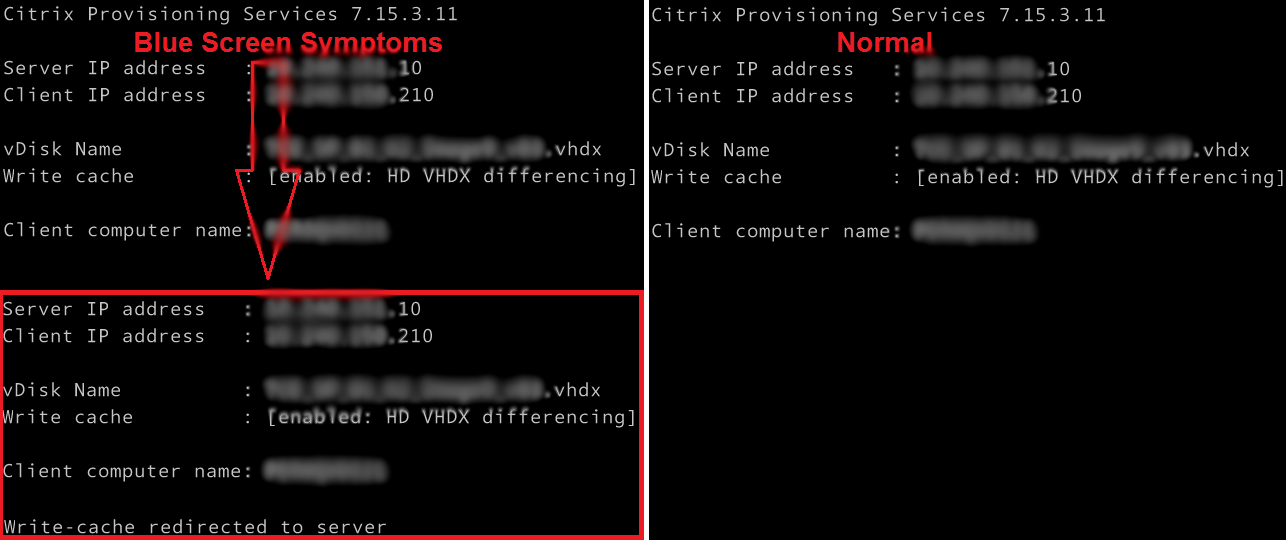
Working on a Citrix upgrade project a few years ago I was continually getting a blue screen when a Citrix PVS image booted. The symptom was obvious during the boot process. It was as if there were two NICs or the image was trying to load twice. PVS write-cache was also incorrectly being redirected to the server.

PVS Target Agent Blue Screen Symptoms

I checked and rechecked all the obvious suspects, such as ghosted NICs and other devices, old DHCP information, antivirus, etc. Everything looked good. It really did not make a lot of sense. I then stripped all the apps and tools out of the build and it worked! So what was I doing wrong?

Read more

Best Practice for the Active Setup StubPath value

It’s been a best practice for a long time to clear the Active Setup StubPath value per application to avoid the Active Setup processes from running at logon, impacting the user experience. This is a challenge we constantly have with Vendors and packaging teams. But blindly clearing the StubPath value could lead to application issues. So what happens when you need to go back and troubleshoot an issue with an application that may be related to what “should have” run via the Active Setup process. How do you know what the StubPath value was originally set to? Do you record it somewhere?

I’ve been running a script for years over my builds that simply renames the existing StubPath value to StubPath.Backup and time stamps it. This way you can always review what it should be, and make the necessary changes to allow for this.

Read more

Cold Starting and/or Hydrating Your Applications To Improve Their Startup Times

In the End User Computing (EUC) space we know that after the first time the application starts post reboot, the next time is faster. The first startup is referred to as a cold startup and all subsequent runs are warm startups. The first time the application starts, components of the application, such as the EXEs (executables) and DLLs (dynamic link libraries) need to be loaded from disk, which can delay the startup time. All subsequent runs will then read the data from the file system cache, which is memory managed by the Operating System.

Hydrate and Cold Start your applications

The way we prepare a system for a user is to cold start (pre-launch) the applications when the system starts. We do this by starting and then terminating each process, such as winword.exe.

Read more

ESRI ArcGIS Pro and Desktop License Type and Program Selector User Interfaces

Updated 17th July 2024

Here are two awesome User Interfaces (UI’s) I built that will compliment any ESRI ArcGIS Pro (AGP) and/or ArcGIS Desktop (AGD) deployment. More specifically from my point of view, they have been developed with a Citrix Published Application, VMware Horizon, Remote Desktop, VDI and AVD deployment in mind, giving the users the ability to easily switch licensing types and launching the different programs and tools, making life much easier for them.

ArcGIS Pro Challenges

  • Changing the licensing is not as simple as it seems, especially when launching it as a published application. This is because you have to change it from within the program once launched; and then the program needs to restart for the new licensing type to work. What that means is that the ArcGISPro.exe process will terminate and restart. Whilst that happens a published application session may log itself off, as there are no processes running to keep it open. The code in this UI will manipulate the user registry values before starting ArcGIS Pro, and therefore setting the licensing type as required. I call this Self-Service by allowing the users to switch License Levels/Types on demand!
  • Having a single interface allowed me to integrate other tools and processes as requested by users over time that could all be associated with ArcGIS Pro. For example, users wanted an easy way to start File Explorer in the same session. Let’s make it easy for the users to do their work! That’s my job!
  • Update on 17th July 2024 for Python code changes I completed in back February:
    • Due to some corporate licensing challenges with ArcGIS Pro, the ArcGIS Pro License Selector has been updated for the following reasons:
    • It defaults to a Basic license, regardless of what you last used. If you need to use a Standard or Advanced license type, please select it before launching ArcGIS Pro. This behaviour can be changed back by using the AlwaysDefaultToBasic script variable as documented below.
    • I have added a “Reset Extensions” checkbox, that is selected by default. This will remove any Extensions you may have selected in your previous session, as the licensing for some of these Extension is also limited. You have the option here of deselecting it if you wish to continue to use previously selected Extensions in your new session. This behaviour can be changed back by using the AlwaysResetExtensions script variable as documented below.
    • Unfortunately, neither of these settings are managed by ESRI at an enterprise level, so I’ve enhanced this tool to assist in reducing the usage of the more advanced licensing options.
    • I have also improved the flow of the Python code.

ArcGIS Desktop Challenges

  • In a large enterprise deployment, setting the licensing model can be a pain. This is done via a user environment variable. So you could use Group Policy Preferences to target them based on AD Security Groups. But that adds an administrative overhead, and users must then log support tickets via the Service Desk, which creates unnecessary overhead and lost time whilst they wait for it to be actioned. That’s not agile, and doesn’t allow users to change their license type to suite their needs. The code in this UI will manipulate the user environment variable before starting the ArcGIS Desktop program of choice, such as ArcMap or ArcCatalog, and therefore setting the licensing type as required. Again, I call this Self-Service by allowing the users to switch License Levels/Types on demand!
  • There are way too many Start Menu items to publish, which is not a neat and tidy way to present it, so why not just present it via a single UI?
  • Having a single interface allowed me to integrate all the common ArcGIS Desktop programs and other tools and processes as requested by users over time that could all be associated with ArcGIS Desktop. For example, users wanted an easy way to start File Explorer in the same session, and they wanted a way to install specific Python modules that are not part of the default Python install. Again, let’s make it easy for the users to do their work! That’s my job.
  • ArcGIS Administrator notes:
$acl= get-acl -path "HKLM:\SOFTWARE\Wow6432Node\ESRI"
$inherit = [system.security.accesscontrol.InheritanceFlags]"ContainerInherit, ObjectInherit"
$propagation = [system.security.accesscontrol.PropagationFlags]"None"
$rule=new-object system.security.accesscontrol.registryaccessrule "USERS","FullControl",$inherit,$propagation,"Allow"
$acl.addaccessrule($rule)
$acl|set-acl
 
$acl= get-acl -path "HKLM:\SOFTWARE\Wow6432Node\Classes\CLSID\{E6BDAA76-4D35-11D0-98BE-00805F7CED21}"
$inherit = [system.security.accesscontrol.InheritanceFlags]"ContainerInherit, ObjectInherit"
$propagation = [system.security.accesscontrol.PropagationFlags]"None"
$rule=new-object system.security.accesscontrol.registryaccessrule "USERS","FullControl",$inherit,$propagation,"Allow"
$acl.addaccessrule($rule)
$acl|set-acl

Read more

XDPing C# Function

I wrote this C# (csharp) function back in 2020 when developing the Self-Service Session Reset Tool. I have since enhanced it for improved error checking and logging and am happy to share it here for anyone else who wants to leverage it. I released a PowerShell version back in 2019. I like to integrate these functions into the scripts and tools I create as part of the health checks I do. I believe that by checking that the Broker’s Registrar service is reachable, listening and processing requests on its configured port, we can only then assume it is in a healthy state.

Read more

Sentinel LDK License Configuration Helper Service

Introducing the Sentinel LDK License Configuration Helper Service. This new tool I’ve created uses registry values and/or XML files to configure the client-side Sentinel LDK License Manager (hasplms) service, which updates the configuration in the License Manager Configuration File (hasplm.ini) found under the “C:\Program Files (x86)\Common Files\Aladdin Shared\HASP” folder on a 64-bit Windows machine. It achieves the same outcome as using the Configuration option from the Sentinel Admin Control Center (ACC) web interface via http://localhost:1947.

Read more

Citrix Self-Service Session Reset Tool Process Flows

***Updated for the release of v1.6.

There are eight (8) main process flows for the how the Citrix Self-Service Session Reset Tool works:

  1. User Opens Web Page Process Flow
  2. Get Sessions Process Flow
  3. Logoff Sessions Process Flow
  4. Disconnect Sessions Process Flow
  5. Restart Machines and Forcefully Restart Machines Process Flow
  6. Hide Sessions and Unhide Sessions Process Flow
  7. Get Processes Process Flow
  8. Terminate Processes Process Flow

Each flow is documented and visually represented below.

Read more

Citrix Self-Service Session Reset Tool

***Please refer to my article on Development Planning for the Citrix Self-Service Session Reset Tool to learn about what updates and new features are being worked on.

***If using a release less than v1.9, please refer to the release history below to understand the new features, enhancements and fixes now included.

This tool has been labelled as a game changer for any Citrix customer. It’s proven time and time again that it has a huge impact on reducing the burden on the Service Desk and Operations Teams by empowering users to get themselves back up and running in the shortest possible time.

No matter how stable your Citrix platform is, one of the biggest challenges for any Citrix customer is being able to reduce Service Desk calls and user downtime by empowering users with the ability to clear their own sessions, or recover them by terminating rogue processes. Several free scripts and a paid for tool are available, but none of them really achieve the best outcome. Some of them still require users to run a “Citrix session”, which they often can not do because the broker may be trying to reconnect them back to a stuck, hung, broken session or unhealthy host. When this happens they get into an endless loop of failure and get very frustrated. This can impact brand reputation and user satisfaction, leaving users with a poor felt experience. Some have even implemented a separate Citrix Environment to run these scripts from. In my opinion this is as waste of resources and an overhead for management. It still doesn’t always work due to Citrix Workspace (Receiver) reconnection issues and is often over complicating it for users.

My goals were to:

  • Create a tool that is easy to use, even for users that struggle with technology.
  • Create a tool that enables users to not only get themselves back up and running in the shortest possible time, but also reduces the reliance on Service Desk and even second level support teams.
  • Create a tool that does not rely on any ICA/HDX connectivity to a Citrix platform. This was extremely important!
  • Create a tool that would allow support for multiple Citrix Virtual Apps and Desktops (CVAD aka XenApp and XenDesktop) Sites.
  • Create a tool that works across trusted Domains.
  • Create a tool that works across the IT and OT landscape.
  • Create a tool that can easily be extended/expanded for other use cases.
  • Create a tool that’s modular so that other brokers such as VMware Horizon and Leostream can easily be added.
  • Create API’s with a Web front-end.
  • Create a tool that can be used to develop a microapp.
  • Create a tool that can easily be called by any scripting language such as PowerShell and Python.
  • Create a tool that can be enhanced, debugged and supported by others.
  • Create a tool for the community, because I love doing that!

Read more

Citrix Virtual Delivery Agent (VDA) Post Install Script

Updated 18th July 2025

Whilst some of these items can be excluded from the Virtual Delivery Agent (VDA) installation, checking and managing them in a post install script ensures we have consistency between all installations and VDA versions. All these actions need to take place in the base image, hence why they are managed in a script and not via Group Policies. This script has been built from years of lessons learnt and developing best practices. It will…

  • Disable the Telemetry Service
  • Disable the VDA Ceip Service
  • Disable the CtxAppVService (from 7.14 to 7.15 CU4/1906)
  • Disable the App-V Package Cleanup (from 7.15 CU5/1909)
  • Disable the Smart Card Services and Launcher
  • Implement the Citrix Desktop Service (BrokerAgent) Scheduled Task
  • Configure the UviProcessExcludes
  • Configure the CtxHooks
  • Configure the UPMEvent
  • Update the BrokerAgent.exe.config file
  • Enable the SaveRsopToFile registry value if it exists

Read more